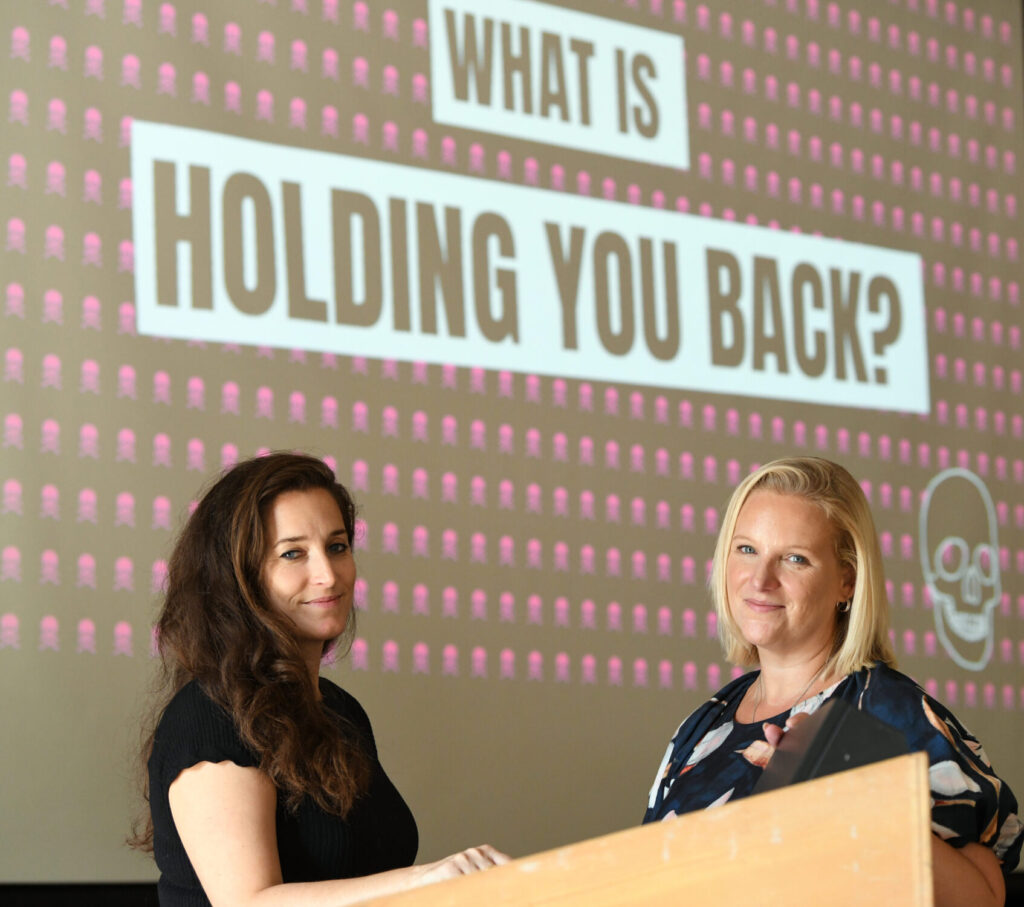
Community Action Suffolk’s Annual Conference is always an opportunity to step back from the day-to-day pressures of our work, connect with colleagues from across the voluntary, community, faith and social enterprise (VCFSE) sector, and explore ideas that challenge us to think differently.
This year’s theme, Be More Pirate, certainly did that.
Led by Alex Barker, business partner to Be More Pirate author Sam Conniff Allende, the conference explored what we can learn from one of history’s most misunderstood groups: pirates.
Alex opened the day not with statistics, strategy or a presentation packed with facts, but with a photograph.
It showed her as a child standing alongside her brothers on their way to a fancy-dress party. The boys were dressed as pirates. Alex wasn’t. She was a mermaid.
Presented with the expectation that she should simply follow the plan, Alex had other ideas. Refusing to dress as a pirate simply because everyone else was, she persuaded her mum to create a mermaid costume instead. It was a small act of defiance, perhaps, but it perfectly captured the spirit of the day ahead.
Because the conference wasn’t asking us to break rules for the sake of it. It was asking us to think about where rules come from in the first place, who created them, and whether they still deserve to exist.
It would be easy to assume that Be More Pirate simply uses pirates as a metaphor for challenging convention. In reality, the conference was very much rooted in the remarkable story of the pirates of the Golden Age of Piracy.
Between 1695 and 1725, in the space of just thirty years, pirate communities developed their own codes, systems of governance and ways of working together in uncertain and often hostile conditions. They created structures that challenged accepted ideas of leadership, fairness and decision-making at a time when many people had little voice at all. While history often paints pirates as villains, the reality is far more complex. They were pioneers, adapting to adversity, collaborating in challenging circumstances and building communities with a shared purpose.
Which raises an interesting question. Who wrote their story?
Throughout the day, delegates were encouraged to consider how narratives are shaped and how perceptions are formed. Pirates challenged existing systems of power. They disrupted accepted ways of working. They rejected assumptions that others considered fixed and unchangeable. Unsurprisingly, those in positions of authority were often responsible for telling the stories about them.
The parallels with modern life were impossible to ignore.
Every organisation, every community and every individual operates within a framework of rules. Some are written down. Some are unwritten. Some are essential. Others exist simply because they always have.
“We’ve always done it this way.”
“That’s just how things work.”
“We tried that before.”
“That will never work.”
Rules do not always appear as policies, procedures or legislation. Sometimes they arrive disguised as assumptions. Sometimes they are inherited from others. Sometimes they are stories we tell ourselves.
One of the most thought-provoking sessions of the day centred around the edges of old maps. Historically, unexplored territories were often marked with warnings. Beyond the boundaries of the known world lay uncertainty, mystery and danger. Sometimes mapmakers simply labelled these places with a phrase that has echoed through history:
Here Be Dragons.
Of course, there were no dragons. There was simply the unknown.
Delegates were invited to consider the edges of their own maps. What sits just beyond the boundaries of what feels comfortable or familiar? What opportunities remain unexplored because they feel too risky? What conversations are waiting to happen? What ambitions have been quietly parked because they seem too difficult, too unlikely or too far away?
The discussions that followed revealed something fascinating. Everyone’s map looked different.
For some, the dragons were funding challenges. For others, they were organisational change, new partnerships, leadership decisions or personal ambitions that remained just out of reach. Yet despite these different perspectives, one thing became clear: we often fear the unknown long before we truly understand it.
For Suffolk’s VCFSE sector, that message feels particularly relevant.
Every day, organisations across our county respond to changing community needs, increasing demand, evolving expectations and ongoing uncertainty. There is rarely a complete map showing exactly what comes next. More often than not, progress comes from being willing to explore new territory, test new ideas and approach challenges from a different angle. That takes courage. Being bold and being brave.
Not the dramatic courage we associate with adventure stories, but the quieter courage to ask difficult questions, challenge established thinking and remain open to possibilities that others might overlook.
That, perhaps, is the enduring message behind Be More Pirate.
The pirates themselves were not simply rebels looking for trouble. They were people who chose to question accepted ways of working and, in doing so, created alternative systems that enabled them to navigate an uncertain world. The challenge for us is not to copy the pirates, but to learn from their willingness to think differently when faced with uncertainty, adversity and change.
As the conference drew to a close, I found myself returning to that childhood photograph. A young girl standing among pirates and deciding that she didn’t have to follow the script that had been written for her. In many ways, it was the perfect metaphor for the day.
Being more pirate isn’t about dressing differently or challenging every convention we encounter.
It’s about having the confidence to think differently, the courage to venture beyond the edge of the map, and the imagination to believe that there may be another way forward.
And perhaps the most important question we can ask ourselves is this:
If there were no dragons on the edge of the map, where would we sail next?
By Jeannie Valentine – EA at Community Action Suffolk
