VCFSE Sector News, Opportunities and Consultations
Community Action Suffolk (CAS) aims to help the Voluntary, Community, Faith and Social Enterprise (VCFSE ) sector in Suffolk. This is to ensure that the VCFSE sector in Suffolk has a voice in areas where we need to influence for the benefit of our communities, and to provide input into the development and growth of Suffolk.
Sector News
Links to Sector News and Reports that may be of interest to the sector will be displayed here on a regular basis.
October 2026
Devolution must deliver for the countryside – not leave it behind, report warns

A new parliamentary report, backed by the CLA, sets out how fair funding and stronger rural representation can unlock the countryside’s economic potential. Devolution has the potential to bring decisions closer to the people and places they affect. But unless rural needs are built into the system from the outset, communities across the countryside risk being left behind. Read more here.
Norfolk and Suffolk libraries team up with NHS to help more people access healthcare online
Libraries across Norfolk and Suffolk are joining forces with the NHS to help more people feel confident accessing healthcare online, as part of Get Online Week 2026, which runs from 19 to 25 October. Read more.

Guidance – SME/VCSE Bid Pack
The Home Office has published a new SME/VCSE Bid Pack, and Social Value features from the readiness checklist through to the evaluation stage. The Home Office notes that SMEs consistently outperform larger suppliers when they lean into strengths such as specialism and community connection. It also states that SMEs and VCSEs are often well placed to deliver Social Value because of their close links with local communities and their ability to respond quickly to local needs.
They say that this Bid Pack is designed to help you get ready. It explains what to expect, how to prepare, where to find opportunities, how to decide whether to bid, and how to present your strengths clearly and confidently. Read more.

Join Our New Ageing Well Webinar Series
We are delighted to continue with our new Ageing Well Webinar Series.
This multi-agency awareness webinar will be centred around Ageing Well – Could an everyday skin cream contribute to a fatal fire?
Join Suffolk partners for an important awareness webinar exploring the often-overlooked fire risks associated with emollient creams and why increasing professional and public understanding of this issue can save lives.
Following Suffolk’s support of the highly successful Norfolk campaign, the Suffolk Safeguarding Adults Board, NHS Suffolk and North East Essex Integrated Care Board, Suffolk Fire and Rescue Service, Suffolk Public Health and partner agencies have come together to strengthen awareness of a risk that affects thousands of people who rely on emollient creams every day.
While emollients are essential in the treatment of eczema, psoriasis and other skin conditions, research has shown that creams absorbed into clothing, bedding and dressings can significantly increase the speed and intensity of fire when exposed to ignition sources such as cigarettes, candles, gas cookers or heaters. Research undertaken by Dr Sarah Hall and colleagues at Anglia Ruskin University has helped highlight the hidden dangers associated with emollient contamination on fabrics and the importance of increased awareness and prevention.
We are privileged to welcome Dr Sarah Hall, who will share the latest research findings and learning from this nationally recognised work.
The webinar will also include a powerful personal testimony from Sherrie Higgins, granddaughter of Jim Rownsley, whose tragic death following a fire fuelled by emollient-contaminated clothing brought national attention to this issue. Through sharing her family’s experience, Sherrie will help us understand the devastating human impact behind the statistics and why raising awareness is so important.
📅 Wednesday 18th November 2026
🕚 3.00 – 4.00 pm
Please click here to register: Ageing Well – Could an everyday skin cream contribute to a fatal fire? – SIGN UP NOW
Join Our New Ageing Well Webinar Series
Following the findings from our recent Ageing Well, Falls and Frailty Survey, we are delighted to continue with our new Ageing Well Webinar Series.
The webinar will be centred around Ageing Well Winter Preparedness. A colleague from Public Health, Communities and Public Safety will discuss that as the colder months approach it is important to think about staying healthy, safe and connected. This webinar will explore practical ways older people can prepare for winter, including vaccinations, keeping warm, preventing falls, maintaining physical and mental wellbeing and accessing local support and services.
Attendees will leave with simple actions that can be used to help stay well throughout the winter season.
📅 Wednesday 25th November 2026
🕚 11:00am – 12:00pm
Please click here to register: Ageing Well Winter Preparedness Webinar SIGN UP NOW
Real Living Wage increase
The new voluntary real Living Wage rates have been announced for 2027. From 1st May 2027, the real Living Wage in London will be £15.45, and the UK rate will be £14.10. Read more.

Sales, leases, transfers or mortgages: what trustees need to know about disposing of charity land (CC28)
Find out about the rules that apply to the selling, leasing or otherwise disposing of charity land including further updates to reflect the changes to different types of leases in England and Wales which have come in from the Renters’ Right Act that came into force on 1 May 2026. Read the Guidance here.
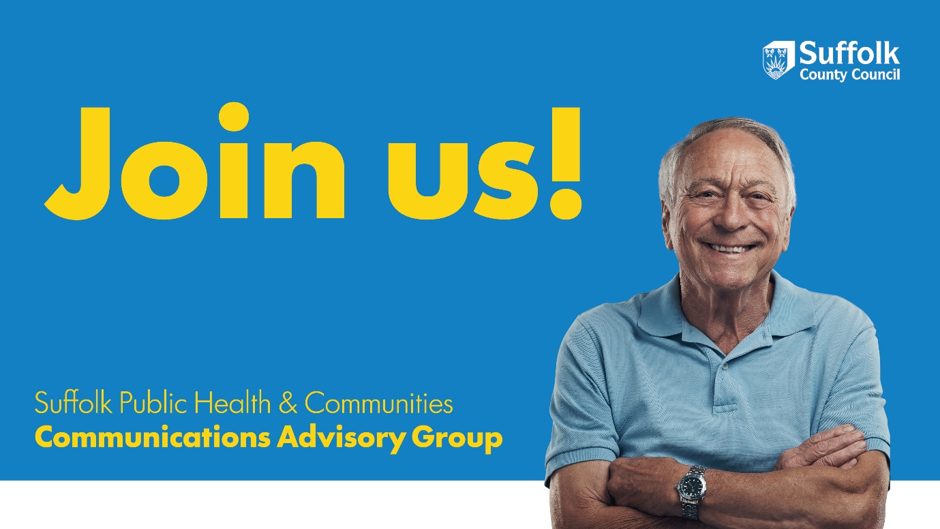
Communications Advisory Group
Thinklusive would like to bring your attention that they are currently working with Suffolk’s Public Health & Communities Team to improve the accessibility of local public health information, and are looking for new members to join our Communications Advisory Group.
The group will advise the Public Health & Communities Team to help ensure local public health information is accessible and easy to understand.
They meet every two months, usually on Zoom. Our next meeting is 27 October 2026, 10am–11.30am.
Accessible information can take many forms, including summaries, videos, audio, Easy Read, large print, good colour contrast and information in different languages.
The NHS Accessible Information Standard sets out how providers and commissioners of NHS and publicly funded adult social care services should ensure disabled people can access and understand information and receive the communication support they need.
They want the group to represent the diverse communication needs of our communities. Anyone is welcome to join, particularly people working across health and care, people with lived experience of disability, and representatives of voluntary and community organisations.
You can find out more here:https://bit.ly/4x4XtYx
Then, sign up here: https://bit.ly/4bU8gMO
If you are interested in improving the accessibility of local public health information, please join the group. And please share this invitation with anyone you think may be interested.
Thank you!
Becca Jackaman
Thinklusive Participant – Accessible Information Consultant

Together for a fairer, greener future – Collective leadership in a time of crisis
A partnership between NPC, Green Alliance and ACEVO facilitated research into climate and nature issues, pointing out that they are inseparable from people’s everyday experiences of housing, transport, health, bills, pollution, flooding and access to green space. But policymaking does not always reflect this reality.
Community knowledge is often gathered or quoted without being given real influence over policy, funding, governance or delivery. This is not simply a problem of representation. It is a problem of power.
Together for a fairer, greener future makes the case for a richer form of collaboration. One that treats communities and grass-roots organisations as partners in shaping problems, priorities and solutions, rather than simply as sources of evidence for decisions made elsewhere. Read the report.

The loneliest generation: What it is like to grow up in England today
The Institute for Public Policy Research (IPPR) have published this concerning report. In it they point out that connection should be the fabric that binds society together, but [that] today’s young people have never felt more disconnected. The report argues that the solutions do not lie in changes to youth policy, [but that] a collective effort is required to offer young people a new settlement that reaches across their lives, on education, work, housing and health. Read the report.

How to build young people’s health and participation in work and education
The Health Foundation, ahead of the final report of Alan Milburn’s review of young people and work, have produced a briefing drawing on the experiences of young people and insights from policy, delivery and academic experts to set out recommendations for government to help young people with health barriers stay in, or return to, work and education. Read the briefing.
Trustees Week (Nov 9-13) might be when your next board member discovers how enriching charity trusteeship can be
Prepare now to help make sure your opportunities reach more potential candidates. The Charity Commission has guidance that can help with:
🖊️ writing a trustee role description
📢 ways to advertise the role
👋 appointing and onboarding new trustees
Find out more in their guidance on finding and recruiting trustees from the Charity Commission and visit Volunteer Suffolk to advertise your role and for further local support from the CAS Volunteering Team.
Digital inclusion for connection: final report
The report provides evidence from a pilot to increase digital confidence and reduce loneliness among disabled adults. The research provides new evidence on how support for disabled working-age adults can better address digital exclusion. It suggests that support is most effective when it combines accessible and suitable technology, connectivity, skills, confidence-building and online safety, and when it is tailored to individual needs and delivered through trusted routes. The findings reinforce that accessibility, and assistive technology should be treated as core elements of digital inclusion, not optional extras. Read the report.

Good boards make good decisions, but what makes a good board?
New research by University of Bath and Charity Finance Group research collaboration bring charity boards a practical tool for optimising composition and boosting effective decision-making.
The DREAM framework for better board decisions
From these findings, the researchers developed the DREAM framework, a practical tool that boards can use to assess decision-making quality, board development needs and recruitment priorities.
- Duration-aware – balancing the short and long term goals
- Risk-considered – weighing risks and downsides, and opportunities
- Evidence-based – grounded in adequate information
- Alternatives genuinely considered – surfacing real options before deciding
- Mission-aligned – serving beneficiaries’ interests first
Read the research report here.

Insights from the Front Line: Understanding the Emotional Toll of Beneficiary Facing Roles in Charities
The Association of Charitable Organisations and Rightsteps who are mental health specialists and part of Turning Point, undertook a survey exploring the emotional impact of beneficiary-facing work and the effectiveness of the support available to those carrying out these roles. Overall, the findings highlight a committed and resilient workforce, but one operating under sustained emotional pressure. This suggests a clear opportunity
for charities to strengthen organisation-wide, proactive approaches to support. Read the report here.
September 2026

All charities urged to check new rules for accounting for 2026
The Charity Commission for England and Wales is urging all charity trustees and professional advisers to read its updated guidance due to changes that apply from this year. Research for the regulator indicates financial transparency underpins public trust and confidence in the £100 billion charities in England and Wales expend delivering impact, so it is vital registered charities continue to submit accurate information on time.
As charities have different accounting requirements based on their legal structure, there is now one guide for each of the three main structure types: a trust or an unincorporated association; a charitable company; a charitable incorporated organisation (CIO).
The guidance has also been updated to reflect two main changes. Firstly, to the Charities Statement of Recommended Practice: Accounting and Reporting by Charities (‘the SORP’); secondly to the income thresholds in charity law at which charities must follow the SORP and have their accounts examined or audited.
The new version of the SORP applies to charities across the UK for financial years starting on or after 1 January 2026 which includes new requirements for recognising and reporting on certain types of income and lease arrangements, and new expectations for increased transparency from big income charities. Click here to read more.
Failing to fund infrastructure is like leaving a restaurant without paying the bill
Most funders understandably want their money to go to the frontline, to see a tangible impact. If you can fund a service that directly helps a child, an older person, a family in crisis or a community, why would you fund the organisation that supports the organisation doing that work? The closure of Reach Volunteering is more than just sad, it raises a fundamental question: how do we expect infrastructure organisations to fund themselves?
In her latest article for the Directory of Social Change, CEO Debra Allcock Tyler argues the case for better funding for infrastructure organisations, and how much stronger the VCSE frontline could be if we properly funded the infrastructure around it. Read the article here.
End Digital Poverty Week begins across the UK
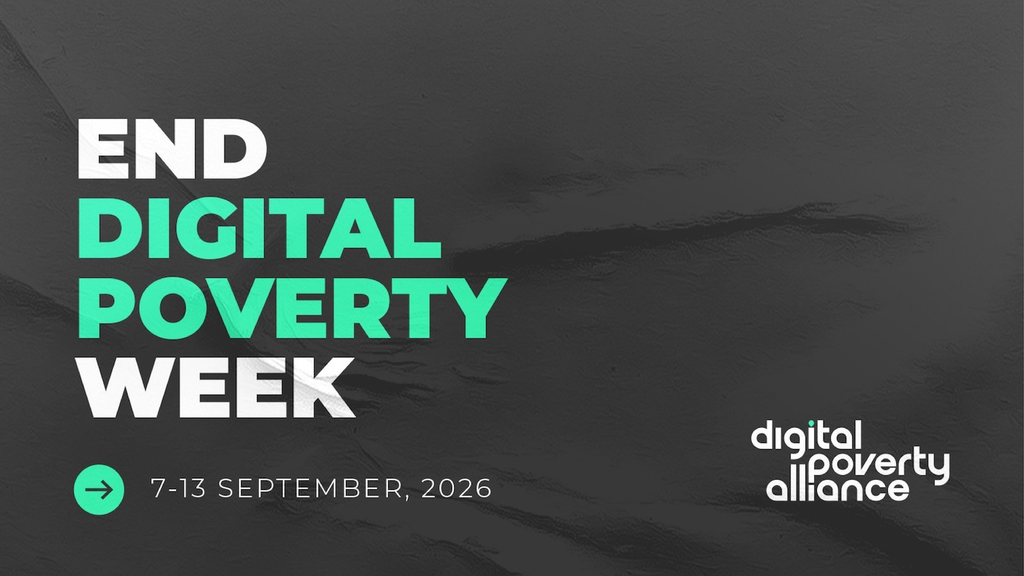
End Digital Poverty Week begins today, marking the first time the Digital Poverty Alliance (DPA)’s annual campaign has expanded from a single day into a full week.
Running from 7 to 13 September, End Digital Poverty Week brings together industry, government and the third sector across the UK to focus attention on the different ways digital exclusion affects people’s lives, from education and employment to accessing essential services, managing money and staying connected. As part of it, the Digital Poverty Alliance have produced a Communications and Fundraising Toolkit which includes messaging, social media content, fundraising guidance and practical ideas that organisation can use to share their own work, support the campaign and take part throughout the week. Click here for more information. The Communications and Fundraising Toolkit can be found here.
Local government reorganisation: programme review and decisions withdrawal letter to council leaders
A letter has bee written to council leaders to advise them that the undertaking a review of the Local Government Reorganisation programme and following updated legal advice (for the avoidance of doubt no privilege is waived) that she has withdrawn the decisions made in March this year for 4 areas:
- Suffolk
- Essex, Southend-on-Sea and Thurrock
- Hampshire, Isle of Wight, Portsmouth and Southampton
- Norfolk
The letter can be read in full here. The documents relating to the government’s programme of local government reorganisation in Suffolk can be found here.

£10 Million Hospitality Grant Scheme launches in boost for independent pubs, restaurants and cafes
Village pubs, family-run restaurants, and cafés receive a boost as a new £10 million three-year Hospitality Grant Scheme has launched for applications. Click here to read more.

Financial hardship delaying major life milestones for young people
New research finds that financial hardship is forcing many young people to delay major life milestones, while millions of young people are struggling to afford essentials.
A survey of more than 4,700 young people aged 16 to 25 across the UK found that financial pressures are forcing young people to delay major life milestones such as moving out, learning to drive and buying a home, while millions are cutting back on essentials including food and toiletries in order to get by.
The research found that almost half (47%) of young people have had to delay moving out of their parents’ home because of financial pressures, rising to 54% for young people who experienced financial hardship growing up. Click here to read more.

Rising Energy Costs Deepen Rural Cost-of-Living Pressures
The Rural Services Network have highlighted that Households are facing renewed pressure on their finances this autumn, as energy bills rise and record levels of debt show that many people are already struggling to keep up.
Ofgem has confirmed that the energy price cap will increase by 4% from 1 October to 31 December 2026. For a typical household paying by direct debit for both gas and electricity, the annualised figure will rise by £60, from £1,663 to £1,723, which is equivalent to around £5 more a month.
However, this does not tell the full story for many rural households.
Homes without a mains gas connection often depend on heating oil or liquefied petroleum gas (LPG). These fuels are not covered by the price cap and must usually be purchased in bulk, leaving households exposed to sudden market movements and large upfront costs.
Action with Communities in Rural England (ACRE) reports that heating oil reached 85p per litre on 26 August, 38% above its pre-war price, after more than doubling during March. ACRE says a typical 1,000-litre order increased in price by £740 in a single week at the height of the surge.
It is calling for further government support for off-grid households, including consideration of temporarily removing the 5% VAT charged on heating oil. ACRE also argues that help must reach low- and middle-income rural households, not only those eligible for the most tightly targeted support. Read the press release here.

The State of UK Volunteer Management 2026: Connected for Impact
A 2026 State of the UK Volunteer Management Report has recently been published by Rosterfy which confirms that volunteers are the heartbeat of communities across the UK. They give their skills, their passion and their time to causes that matter to them, and against a backdrop of stretched budgets and busy lives, they keep showing up. From food banks and community gardens to cultural festivals and national events, the people who give their time – and the people who lead them – remain a quiet, powerful force for good. Some headlines stand out. This year 92% of organisations say volunteers are critical to delivering their mission, up from 88% in 2025. And for the first time in two years of asking, the sector is telling us that recruitment is getting easier: 46% now say it is easy to recruit volunteers, up sharply from 35% last year. Almost half (49%) report that their volunteer numbers have grown. Read the report here.
August 2026
Community Organisation and Climate Action
Research and practical resources to support community organisations, charities, social enterprises and community businesses to tackle climate change, including an assessment of different approaches, business models and examples to help take climate action. Read more at: https://locality.org.uk/reports/community-organisations-climate-action
Charity Sector Risk Assessment 2026
The Charity Commission has produced a high-level picture of the risks facing the sector now or in the future, in order to help trustees take proportionate steps within their own context to prepare. This report has been produced to provide an overview of potential risks to the charity sector at the present time, drawing upon the Commission’s data as well as horizon scanning and gathering of insights from sector bodies and others with knowledge of the sector.
Every charity’s exposure to these risks will vary. This report is produced to support trustees and charity leaders to understand the risk landscape and to support decision making. It illustrates the complexity of a sector intricately bound up in our society – operating in places where others cannot, and supporting some of the most vulnerable in our communities. Read more at: https://www.gov.uk/government/publications/charity-sector-risk-assessment-2026

Through the Roof: The case for investing in the energy efficiency of community buildings
Community buildings play a vital role in bringing people together, providing essential services and strengthening local communities. From community centres and village halls to sports clubs, shops and cafés, these spaces are at the heart of local life and provide important places for connection, wellbeing and collaboration.
Yet many community buildings are ageing, poorly maintained and increasingly expensive to run. Rising energy costs are placing additional pressure on charities and community organisations, many of which have limited capacity and rely heavily on volunteers. For organisations already facing financial pressures, poor energy efficiency can threaten their ability to keep buildings open and continue delivering vital services. Read more: https://www.groundwork.org.uk/through-the-roof-vcse-report/

Some charities will always rely on grants, impact economy researchers say
Researchers mapping out the different types of organisations that make up the impact economy have said that some charities are and should remain funded wholly or mainly by grants.
New Philanthropy Capital (NPC) and Social Investment Business’s Designing the right finance for the right organisations splits the impact economy into five segments, with most charities falling into the first two “regulated” sections.
It follows an earlier report by NPC, which valued the UK’s impact economy at £428bn, with £323bn of the total attributed to “self-regulated” impact-led businesses, but drew some concerns over its definitions. Read more: https://www.civilsociety.co.uk/news/some-charities-will-always-rely-on-grants-impact-economy-researchers-say.html
Equality Act 2010: Code of Practice for services, public functions and associations, 2026
The Equality and Human Rights Commission’s updated Code of Practice for services, public functions and associations has come into force across Great Britain. The underlying legal duty to make reasonable adjustments hasn’t changed, but the revised Code reinforces an important point that Organisations should consider barriers BEFORE disabled people encounter them, not wait until somebody struggles or complains. Read the guidance.
Banking admin takes up 12 million hours of charity time each year
Charities across the UK are collectively spending an estimated 12 million hours every year on banking administration, according to Charity Banking Report 2026, published by the Charity Finance Group (CFG). That’s the equivalent of around 6,000 people working full-time, all year, on nothing but banking tasks. Read the full article and download the report: https://cfg.org.uk/news/banking_administration_takes_up_12_million_hours_of_charity_time_each_year
Charities advised to comply with updated Code of Practice
The updated Code of Practice from the Equality and Human Rights Commission (EHRC) has now taken effect. Charities are therefore advised to take steps towards ensuring they can comply with the Code and the law, notably the changes regarding the definition of sex under the Equality Act 2010 as relating to biological sex.
Such steps might, depending on the nature of a charity’s work, include seeking legal advice. Meanwhile the Charity Commission is working at pace to update its Equality Act guidance for charities. It aims to publish this guidance during the Autumn. Read more: https://www.gov.uk/government/news/charities-urged-to-prepare-for-compliance-with-ehrc-code-of-practice
Reuse in charity digital: free tech support for charities
CAST and The Tech for Good Alliance have been talking to charities about their tech problems – and have discovered that many are facing the same ones, including writing case notes efficiently, running events, managing fundraising applications and creating impact reports. The Tech for Good Alliance has started building tools to address these shared challenges – and is also identifying other challenges across the sector. With support from Lloyds Bank Foundation for England and Wales’ Financial Resilience Fund, The Tech for Good Alliance can now offer free support to build new tools, or access the existing shared tools. They are particularly interested to hear from small to medium-sized charities – typically with a turnover of between £100,000 and £3m – which provide some support around financial resilience.
If your charity is interested, please contact [email protected] for an informal chat. Or to see the tools in action and ask questions live, book a place on the next ‘Ask Me Anything Digital’ webinar (taking place on Wednesday 19th August at 2pm).
Civil society groups respond to government’s social value procurement changes
Sector bodies have responded to the government’s plans to change how social value weighting is applied to public procurement.
Until now, public contracts assigned a 10% weighting to social value, meaning bidders’ social, economic and environmental commitments were given at least this much consideration.
The Cabinet Office this week revealed plans to remove the social value weighting from all contracts under £1m while increasing the score to 20% for tenders £5m or more.- See more at: https://www.civilsociety.co.uk/news/civil-society-groups-respond-to-governments-social-value-procurement-changes.html

VCSEs: A guide to working with government
A guide for VCSE organisations on how to bid and win contracts with government.
The expertise of charities, public service mutuals and social enterprises (‘VCSEs’) means they are often ideally placed to help create compassionate, responsive and efficient public services. Claire Dove CBE – VCSE Crown Representative is working alongside the Cabinet Office and the Department for Digital, Culture, Media and Sport (DCMS), other government departments and the sectors to unlock the barriers that have prevented VCSEs entering the public sector market in the past.
They have created this guide because they are committed to bringing more charities and social enterprises into public sector supply chains. Read more: https://www.gov.uk/guidance/vcses-a-guide-to-working-with-government
Major funder plans to reduce burden of application processes after feedback
The Paul Hamlyn Foundation (PHF) has said it aims to reduce the burden of its application processes following comprehensive feedback from both grantees and declined applicants.
PHF has published findings from its latest feedback survey, in which its more than 700 respondents praised the funder’s switch to providing more multi-year unrestricted grants in recent years.
– See more at: https://www.civilsociety.co.uk/news/major-funder-plans-to-reduce-burden-of-application-processes-after-feedback.html

Record numbers cannot afford the essentials: JRF (Joseph Rowntree Foundation’s) cost of living tracker, summer 2026
More people than ever are going without essentials, and an increasing range of families are being affected by the cost of living crisis, but it doesn’t have to be this way — as our latest survey also shows, government policy can have an impact.
Following his re-election to Parliament, the new Prime Minister Andy Burnham talked of the need to “… do something to make life more affordable, to put more money in people’s pockets, to give people more breathing space again so that they can have a better life”. Our latest survey shows that a record number of families across the UK desperately need him to act upon those words.
The cost-of-living crisis is becoming more widespread, with 7.4 million low-income families unable to afford essential items in the last 6 months — the highest number since we began running our cost of living tracker survey in 2021. Read more: https://www.jrf.org.uk/cost-of-living/jrfs-cost-of-living-tracker-summer-2026

Health as an economic asset: Unlocking the economic potential of the UK’s working-age population
This report aims to shift the dial on how we think about health – moving from treating ill health as a cost to seeing good health as a national economic asset. Improving health would strengthen growth, expand the tax base, reduce fiscal pressures and raise living standards. Read more here – https://www.health.org.uk/reports-and-analysis/reports/health-as-an-economic-asset
July 2026
June 2026
May 2026
April 2026
Consultations
Links to Surveys and Consultations that may be of interest to the sector will be displayed here on a regular basis.
October 2026

Research Opportunity from the Department for Education – seeking 16-24 year old participants in Suffolk and Norfolk
Aged 16-24 in Norfolk or Suffolk?
Do you find it challenging to find education, training or work?
We’re looking for young people to help test a new website designed to support your next steps.
⏱️ 45-60 minute online or in person session
🎟️ £30 voucher if selected
Register your interest: Register your interest in taking part in research with the Department for Education – Fill in form
September 2026
Have Your Say On Lottery Funding
The Government is inviting individuals, organisations and communities across the UK to help shape how National Lottery Good Cause funding is distributed in the future.
The National Lottery Good Causes: Fund What Matters to You call for evidence asks what is working well, where funding should be directed and how it could become easier for communities and smaller organisations to access.
This is an important opportunity for rural councils and organisations to highlight the particular challenges faced by rural communities, including limited organisational capacity, the reliance on volunteers and the difficulty of competing for funding through complex application processes.
RSN members are encouraged to respond and ensure that rural needs and experiences inform any future changes.
The call for evidence closes at midday on 23 September 2026.

Department of Health and Social Care
The Department of Health and Social Care want to hear from people in a wide variety of roles and settings across adult social care.
Your experiences and insights can help shape the future of the sector.
Take part in their survey and make your voice heard.
Complete the survey today: https://insights.ipsosinteractive.com/mrIWeb/mrIWeb.dll
The State of AI & Black Communities
Wherever you are in the world, your experience of AI counts. This is the first survey, to our knowledge, to map how the global Black community lives with AI, and to carry what it finds into national and international policy conversations. Click here to take part.
For East Suffolk Organisations – Work Experience for Young People
We all know there’s a huge issue at the moment with young people and work. Due to the rising costs of employing young people it’s now less attractive to recruit them, particularly since they tend to come with limited experience in the work place. One of the key pieces in this puzzle is work experience. We’ve seen really good examples of activity funded by East Suffolk Council including work experience for young people while delivering benefits for residents – for example, community cultural events where young people studying creative degrees have secured invaluable and relevant work experience in helping plan and run these events.
We’d love to understand whether your organisation currently offers work experience, how that works if you do, how it could work if you don’t and what support you might need. Please take a few minutes to complete our questionnaire and hopefully we can work together to get vital work experience for more young people in East Suffolk.
Alex Heys, East Suffolk Council
https://eu.surveymonkey.com/r/QLP5VHH

Healthy lifestyle survey
Feel Good Suffolk is currently promoting a short survey about healthy lifestyle support in Suffolk.
We are keen to reach both those people who have used our service and those who haven’t. The survey only takes a few minutes and the feedback will help what people need, what gets in the way and how healthy lifestyle support could work better. The survey can be found here. It’s running until 1st October so if you can complete and share it with your contacts and networks too this would be much appreciated.
August 2026

To better understand the experiences and needs of the carers of sufferers from cancer, a national survey is taking place in which they are invited to contributed their views. East of England Cancer Alliance is a partner in the project that is being run throughout the UK in conjunction with other organisations. The survey is open to anyone who provides unpaid care or support to a family member, friend, neighbour or another person affected by cancer and cannot manage without support. The results of the survey will be used to produce a report and recommendations that will inform work programmes from 2027. The survey closes at the end of October. Participation is enabled by clicking here.
Help shape the next Suffolk All Age Carers Strategy (2027–2030)
Help Suffolk County Council to in reaching unpaid carers across Suffolk, including adult carers, parent carers and young carers.
Suffolk County Council know that many organisations across the county support people who care, often unseen, for someone. This includes adults caring for a partner, relative or friend, parents caring for a child with additional needs, a disability or health condition, and children and young people who take on caring responsibilities for a family member. We are keen to make sure the views and experiences of all these carers are properly heard, and would be grateful if you could help spread the word.
There is a survey being run at the moment aimed at unpaid carers of all ages to help them better understand the experiences and needs of unpaid carers in Suffolk.
Below are three posters with a QR code to the survey; one for adult carers, one for parent carers, and one for young carers. If you could choose the one more suited to your situation that would be great.
Alternatively, here is the link to the survey – Help shape the next Suffolk All Age Carers Strategy (2027–2030) – Fill in form
Please feel free to share the posters, or link to colleagues, service users, parents, young people, volunteers, or anyone in your network who may be a carer, or know someone who is, whatever their age.
The survey shouldn’t take any longer than 5-10 minutes to complete (responses dependent of course). All responses are anonymous with an option at the end to add an email address if they’d like to be involved in follow up feedback.
This work is part of Suffolk’s All Age Carers Strategy refresh as Suffolk County Council are trying to make sure that carers voices are captured as part of reshaping priorities for Suffolk as a partnership to focus on for unpaid carers. A copy of the current strategy can be found on the Suffolk County Council website.
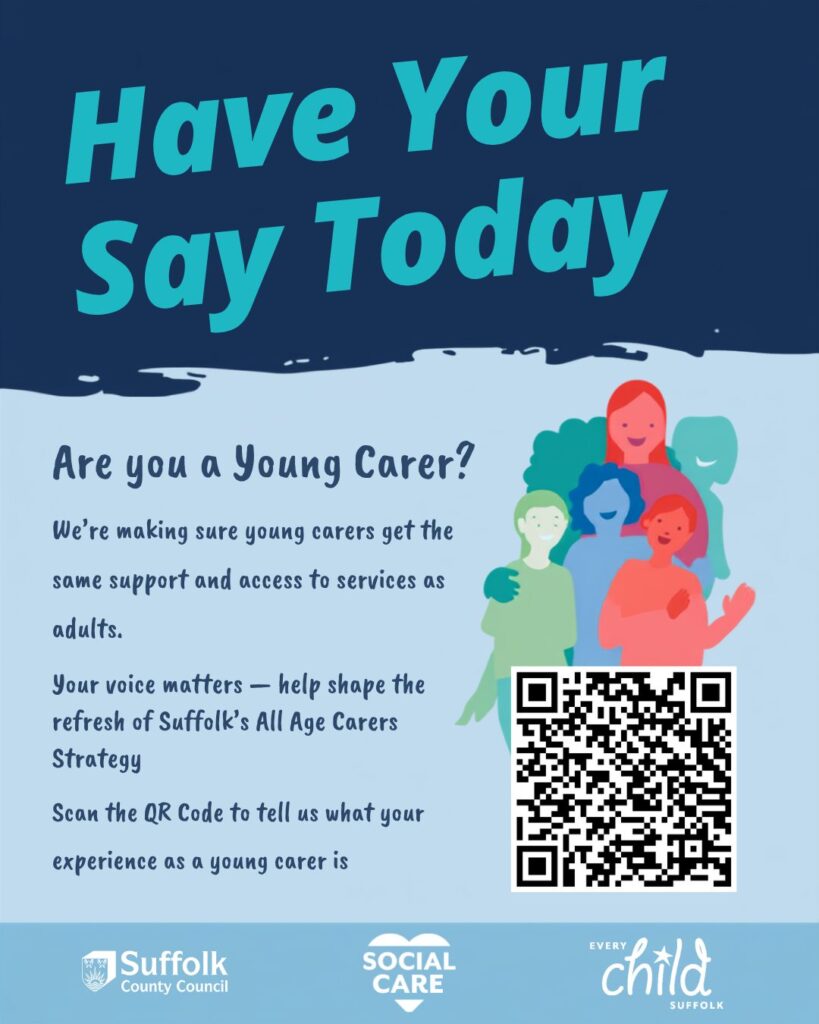
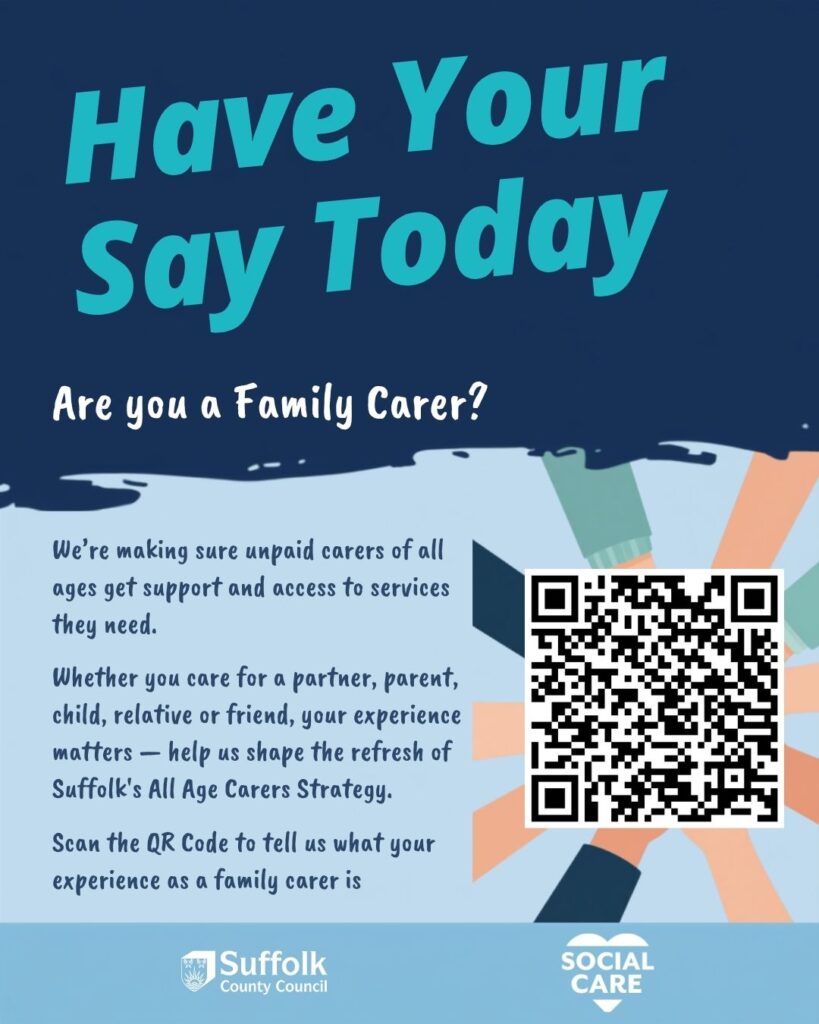
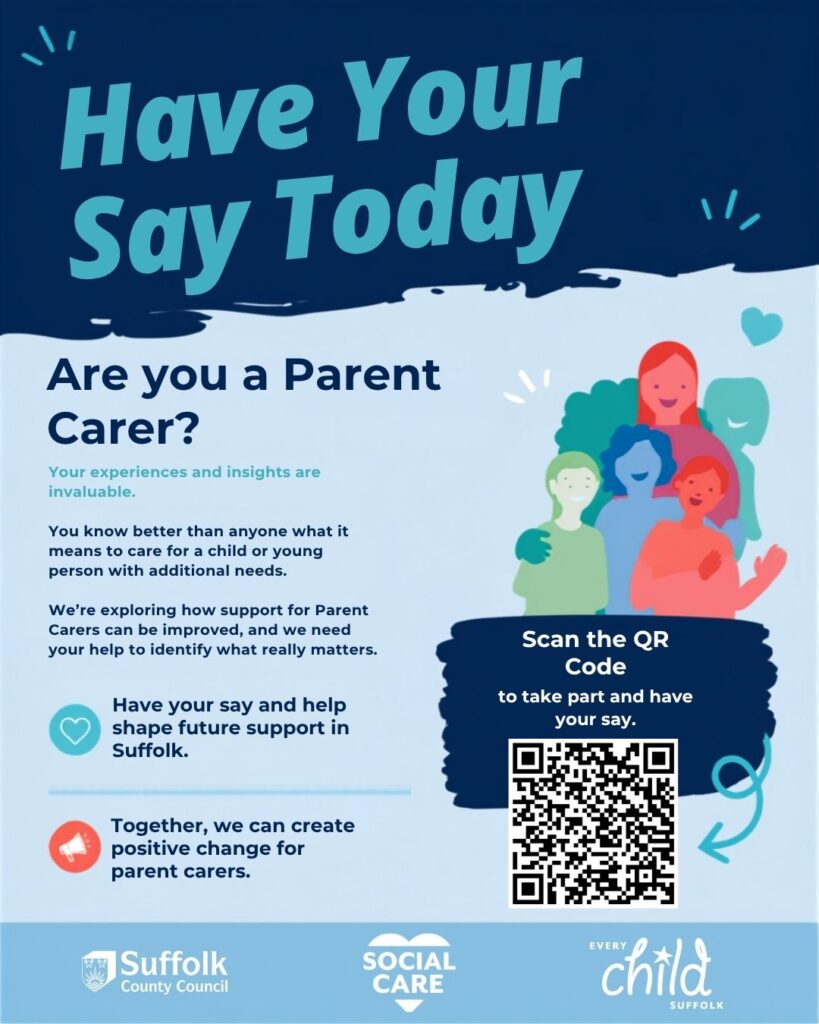
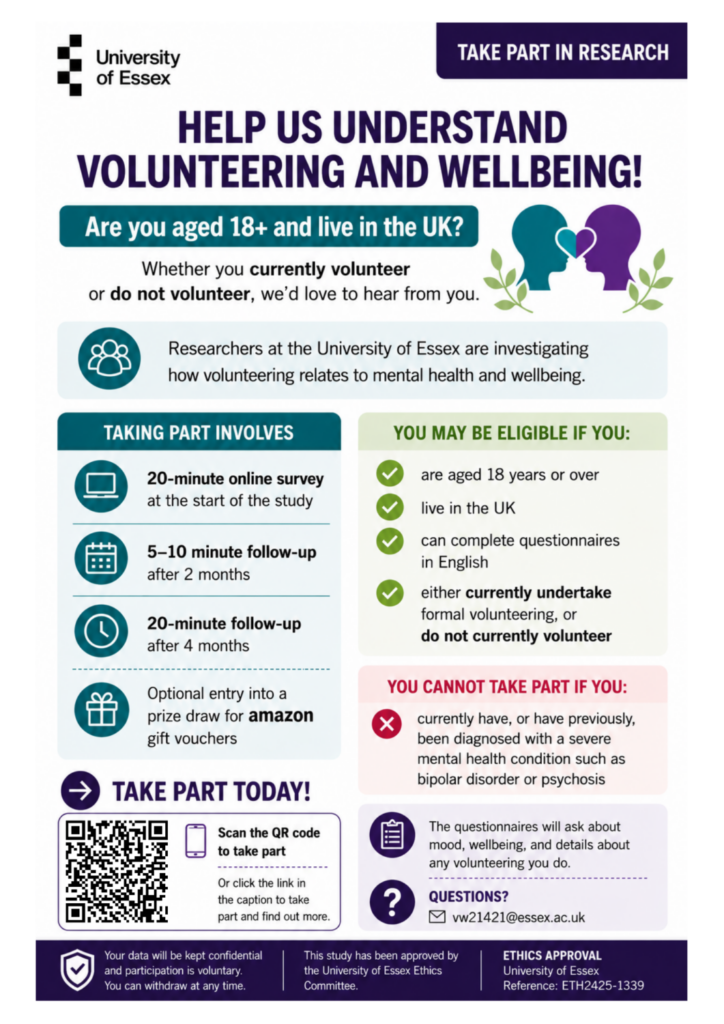
Please find the link to the survey here: https://essex.eu.qualtrics.com/jfe/form/SV_3wpAPKRiVysbLTg
Promoting Independence, Recovery and Wellbeing in Suffolk – new survey from NHS Norfolk and Suffolk ICB – please complete by 24th August
Have you or someone you care for used independence and recovery care services in Suffolk? These services provide short-term support to help people regain independence, recover after illness, injury or a stay in hospital, and build confidence in managing daily life at home.
We want to hear about your experiences. Whether your feedback is positive, negative, or somewhere in between, your views can help shape future services and ensure people receive the right support at the right time.
Share your story and have your say: Promoting Independence, Recovery and Wellbeing in Suffolk
✅ Share the ‘little things’ that would have made a big difference for you.
✅ Tell us your whole experience or story from before you needed support to after your care had finished.
✅ Let us know if there was anything missing from your care or support.
Every response will help us better understand people’s experiences and inform future service development.
Get in touch before 24 August.
Complete the survey here: https://www.letstalkhealthandcare.co.uk/irw-suffolk
Watch this space: a new strategic direction for UK media – green paper and public consultation
The government is consulting on measures to ensure our media, and television in particular, can continue to play its vitally important role in our society and our democracy.
This consultation closes at
Was this page helpful? Please click here to rate how useful you found it and share any additional feedback about how we might improve it.
